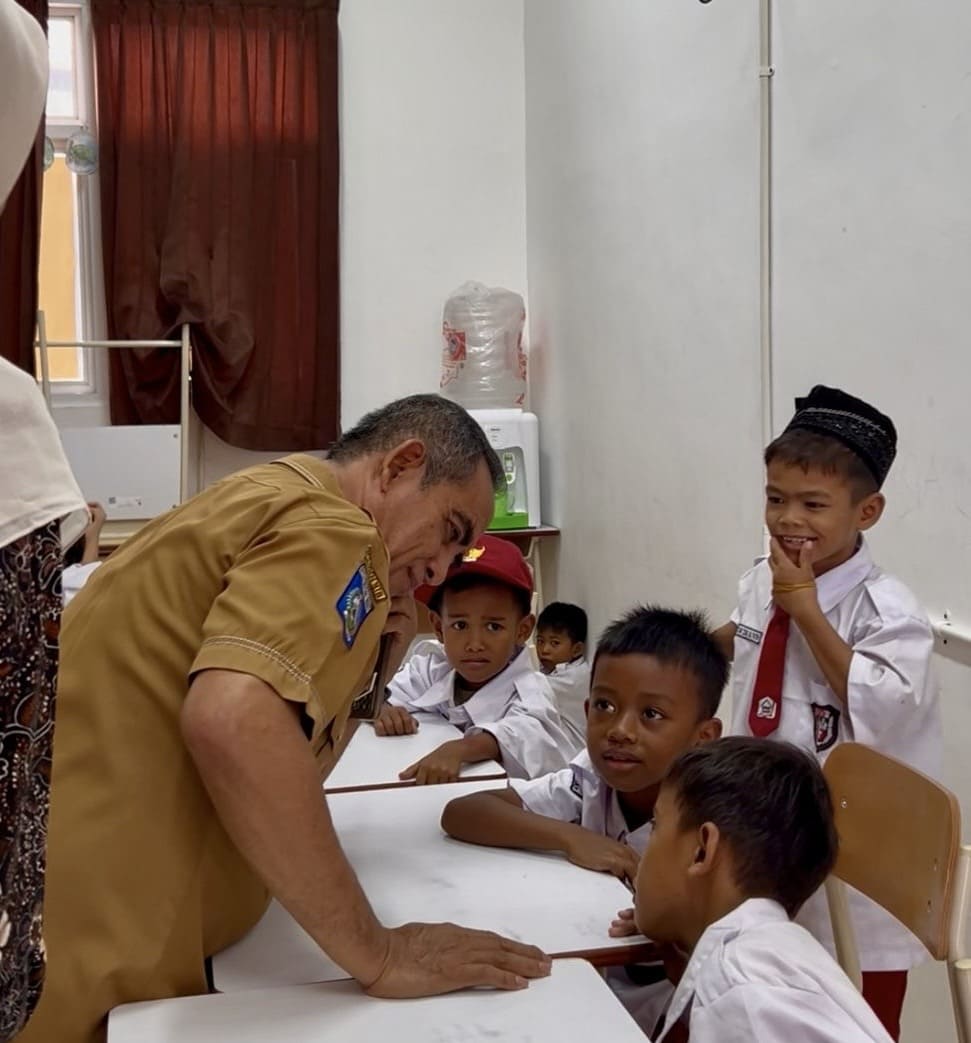
Pojok NTB – That morning, the sound of children’s laughter echoed across the courtyard of Gunungsari Elementary School 4 in West Lombok. Among them was a small boy with a wide smile on his face. His name is Abdu Rahman. That smile was not merely a sign of fleeting joy, but a reflection of a profound change in his life.
For Abdu, school is not just a place to learn. It is a second home—a place where his basic needs are met, where he is cared for, and where his dreams are slowly taking shape.
“I enjoy going to this school because I have lots of friends, the teachers are kind, and everything is provided—food, a place to sleep, and school supplies,” Abdu said innocently, yet with deep gratitude.
That simple sentence tells a long story about a life that was once marked by hardship. Abdu clearly remembers what his days were like before he attended the People’s School. “Back then, we only ate what was available—dry rice with moringa leaves. The rice was hard, too,” he recalled softly.
Now, Abdu’s daily routine has changed. Warm and nutritious meals are served regularly. He no longer worries about going to bed hungry or about whether he will be able to eat the next day. At the People’s School, everything is organized, comfortable, and filled with care.
“Everything is good here. It’s comfortable,” he said briefly, yet meaningfully.
Behind this transformation lies a period of adjustment that was not always easy. Dian Galuh Pratiwi, one of the teachers at the People’s School, explained that the first month was particularly challenging for some children.
“During the first month, many children feel homesick. If they’re not homesick, they complain of stomachaches,” she said.
However, these complaints were not caused by poor nutrition, but by the children’s bodies adjusting to a new, more structured way of life. “Previously, their eating schedules were irregular. Sometimes they ate, sometimes they didn’t. Here, everything is regulated—breakfast at 7 a.m., snacks afterward, lunch after midday prayers, and dinner after evening prayers,” Dian explained.
This shift in eating patterns gradually helped the children’s bodies adapt. Small moments, in fact, often turned into touching stories. “Some children say, ‘Here, I get to eat chicken.’ At home, they were used to eating dry rice that had been reheated,” Dian said with a gentle smile.
Slowly but surely, the complaints subsided. The children became healthier, happier, and more focused on their studies. The People’s School does more than provide education; it restores a sense of security and dignity to children who once lived with severe limitations.
For Abdu, the People’s School has opened the door to dreams. With sparkling eyes, he shared a simple yet meaningful hope. “I hope my teachers stay healthy and have smooth livelihoods. One day, when I become successful, I want to meet Mr. Prabowo,” he said, smiling.
The hope may sound simple, but it carries great weight. It comes from a child who now believes that his future is worth fighting for.
Abdu Rahman’s story is one of many that show how education grounded in humanity can change lives—from a plate of dry rice to nutritious meals, from anxiety to security, and from limitation to hope.