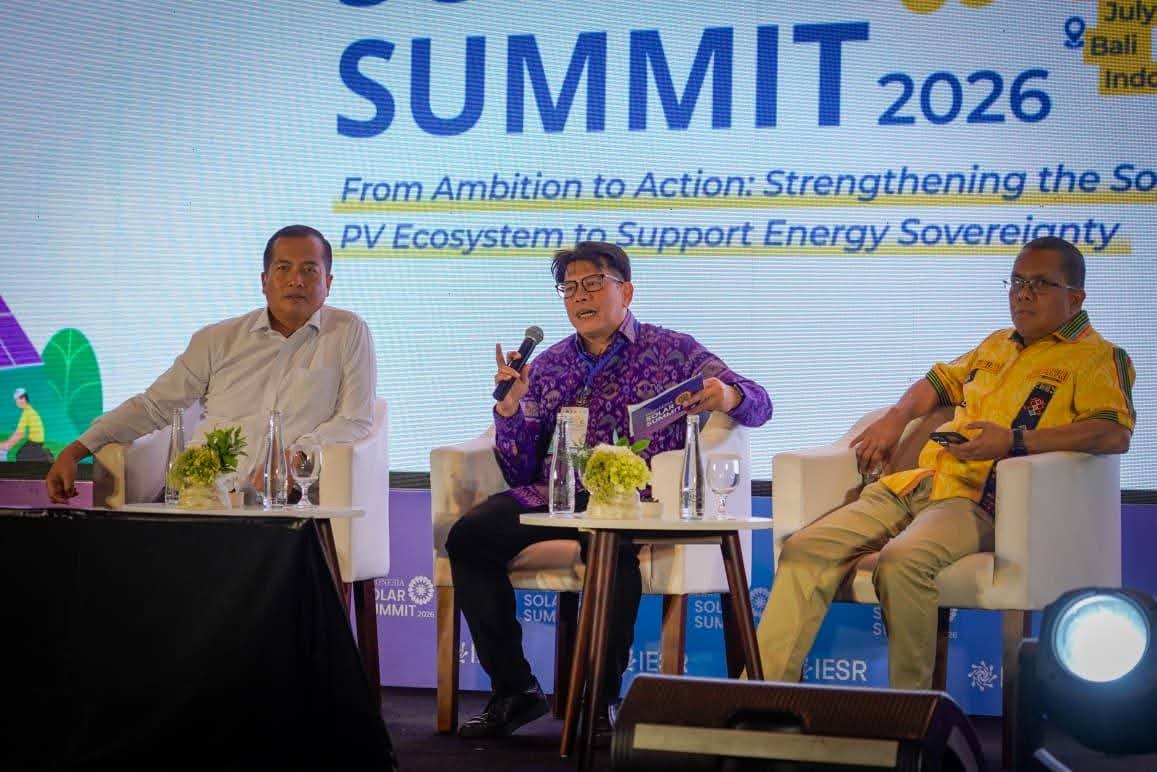
Pojok NTB – West Nusa Tenggara (NTB) Governor Dr. H. Lalu Muhamad Iqbal has unveiled an ambitious vision to transform Bali into a world-class green tourism destination powered by renewable electricity supplied from West Nusa Tenggara (NTB) and East Nusa Tenggara (NTT). The proposal was presented during the Indonesia Solar Summit (ISS) 2026 in Bali on Tuesday (July 14, 2026), as part of a broader initiative to establish the Bali–NTB–NTT region as Indonesia’s clean energy hub.
Governor Iqbal shared the vision while speaking as a panelist at the forum organized by the Institute for Essential Services Reform (IESR) under the theme “From Ambition to Action: Scaling the 100 GW Solar Frontier for National Energy Sovereignty.” The event brought together government officials, industry leaders, investors, academics, and international partners to discuss accelerating solar energy development toward Indonesia’s national target of 100 gigawatts (GW).
During the discussion session, “The Role of Provincial Governments in Advancing Solar Power Development Toward National Energy Independence,” Governor Iqbal emphasized that the regional cooperation between Bali, NTB, and NTT has the potential to become a national model for clean energy-based regional development.
“Imagine Bali becoming a truly 100 percent green tourism destination. Bali would no longer need to build its own power plants because its electricity demand could be supplied by NTB and NTT. Both provinces have enormous solar energy potential,” Governor Iqbal said.
According to the governor, NTB has a strong foundation to realize this vision. The province currently has 77 dams, including 15 major reservoirs with significant potential for the development of floating solar photovoltaic (FPV) power plants.
He explained that utilizing approximately 20 percent of the surface area of these reservoirs for solar panel installations could generate more than 500 megawatts (MW) of electricity. Combined with NTT’s renewable energy potential, the two provinces could supply an estimated 5 to 7 gigawatts (GW) of electricity within the next five years.
To support this vision, the NTB Provincial Government is promoting the development of a super grid connecting the electricity systems of Bali, NTB, and NTT. The interconnection would create a more reliable regional power network, increase the share of renewable energy in the electricity mix, and strengthen Indonesia’s national energy security.
Governor Iqbal also stressed that accelerating the energy transition requires strong investment support. To encourage this, the provincial government is preparing NTB Capital, an initiative designed to enhance investor confidence by streamlining licensing procedures and helping resolve social issues surrounding investment projects.
“NTB Capital will serve as an assurance for investors. We will help accelerate licensing processes while facilitating solutions to social issues that may arise around investment sites,” he said.
In addition to investment incentives, the governor called for improvements to several national regulations to accelerate renewable energy development. One proposal is to grant Special Economic Zones (SEZs) the authority to establish independent off-grid electricity systems through the allocation of dedicated electricity business areas.
He noted that such a policy would accelerate solar energy utilization in areas such as Mandalika, which enjoys exceptionally high solar irradiation and has the potential to generate around 100 MW of solar power.
Governor Iqbal further proposed allowing regional governments greater flexibility to market renewable electricity directly to consumers and even international markets, while maintaining the integrity of Indonesia’s national electricity system.
“When the government opens greater opportunities for renewable energy development, regional governments should also be given the flexibility to maximize their renewable energy resources for broader markets,” he said.
The proposal received support from East Nusa Tenggara Governor Emanuel Melkiades Laka Lena, who reaffirmed NTT’s readiness to become a major renewable energy investment destination. He stated that NTT possesses an estimated 396 GW of renewable energy potential, supported by high solar irradiation and a long dry season, making it highly suitable for large-scale solar energy development.
Governor Melki added that the NTT Provincial Government is committed to providing simplified licensing procedures, spatial planning certainty, land availability, and a conducive investment ecosystem for investors.
The vision of developing the Bali–NTB–NTT region as Indonesia’s clean energy hub offers not only a pathway toward national energy independence but also the opportunity to create a new center of green economic growth. With abundant solar resources, strong local government support, and regional collaboration, eastern Indonesia is well positioned to become a driving force in the country’s energy transition while strengthening Indonesia’s competitiveness on the global stage.